
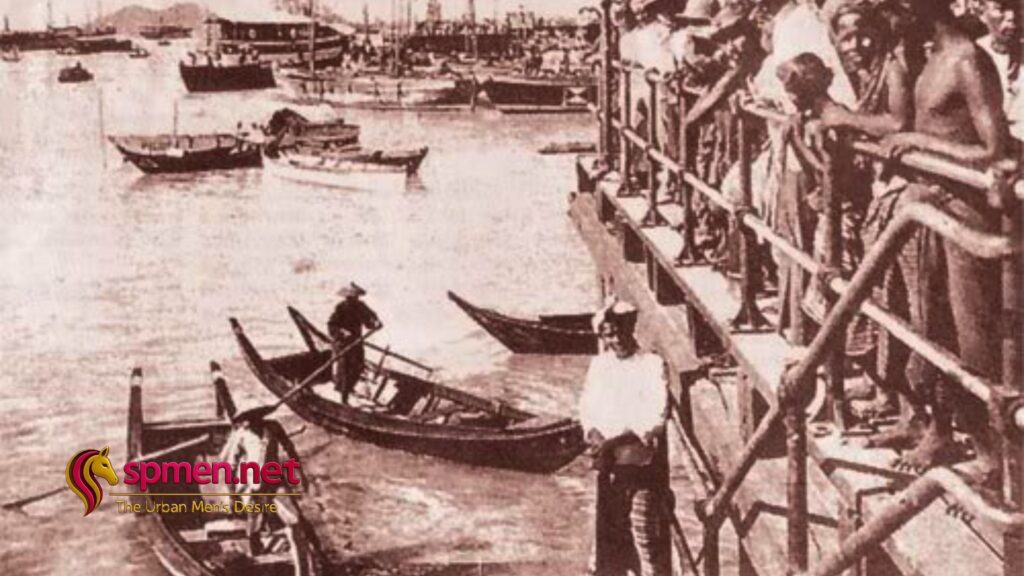
The History of Penang Island
From Ancient Trade Routes to British Colonial Rule
Penang, strategically located at the northern entrance of the
Straits of Malacca, has long played a crucial role in regional trade,
maritime navigation, and colonial expansion.
Before becoming part of modern Malaysia, Penang passed through
multiple historical phases that shaped its unique multicultural identity.
Early Origins and Ancient References
Penang was originally part of the Sultanate of Kedah.
The island’s earliest recorded name,
“Ping-lang-yu” (Island of Betel Nut or Areca),
appears in Chinese maritime charts associated with the voyages of
Zheng He (Cheng Ho) during the early 15th century.
These maps were later reproduced in the military treatise
Wubei Zhi, compiled around 1621.
These early references confirm Penang’s importance as a known waypoint
along the historic maritime trade routes connecting
China, Southeast Asia, India, Arabia, and Europe.

Portuguese and Early European Encounters
In the 16th century, Portuguese traders sailing from Goa to the Far East
discovered Penang as a convenient stop for fresh water and supplies.
They referred to the island as Pulo Pinaom.
Due to its sheltered harbour, Penang soon attracted
Chinese, Indian, Arab, and European vessels,
particularly during the monsoon seasons.
However, its strategic position also made it vulnerable to piracy,
turning the surrounding waters into contested maritime territory.
Arrival of the British and Francis Light
One of the earliest English visitors to Penang was
Sir James Lancaster, who arrived in 1592 during his voyage
to the East Indies.
Nearly two centuries later, Penang’s destiny changed dramatically
with the arrival of Captain Francis Light.
In 1786, the island was ceded to the
British East India Company by
Sultan Abdullah Mukarram Shah of Kedah
in exchange for promised military protection.
On 11 August 1786, Light formally took possession of the island,
renaming it Prince of Wales Island.
This marked Penang as the first British possession
in the Malay States and Southeast Asia.

Foundation of George Town
The settlement that developed around the harbour
was named George Town,
in honour of King George III of the United Kingdom.
Fort Cornwallis was constructed to protect the settlement,
and Light became the first Superintendent of the island.
Legend has it that Light fired silver coins into the jungle
to motivate labourers to clear the land quickly.
By the late 18th century, the town had taken shape,
with early streets such as Beach Street, Light Street,
Pitt Street (now Masjid Kapitan Keling Street),
and Chulia Street forming the city’s core.
Free Port and Rapid Growth
Francis Light declared Penang a free port,
a strategic move that attracted merchants away from Dutch-controlled ports.
Traders from China, India, the Middle East, and Europe
flocked to the island.
By 1789, Penang’s population had reached approximately 5,000,
doubling within a decade.
The Chinese community was led by
Koh Lay Huan, appointed as the first
Kapitan Cina.
Political Conflicts and Expansion
Unbeknownst to the Sultan of Kedah,
Francis Light had promised military protection without approval
from the East India Company.
When Kedah was later attacked by Siam,
the Company failed to intervene.
In 1790, the Sultan attempted unsuccessfully to retake Penang.
Eventually, Kedah formally ceded the island in exchange
for an annual honorarium.
In 1800, Province Wellesley
(Seberang Perai) was added to Penang.
Colonial Administration and Trade
Penang’s status was elevated to a British Residency in 1805.
Notable figures such as Stamford Raffles
and John Crawfurd passed through the island,
contributing to its administrative and strategic importance.
During the early 19th century, Penang served as a staging post
for the opium trade between India and China.
Licensing of gambling houses, brothels, and opium dens
became a major source of colonial revenue.
Legacy and Modern Penang
Francis Light died in 1794 and was buried at the Protestant Cemetery
on Northam Road.
His legacy remains deeply embedded in Penang’s urban fabric.
Today, Penang stands as a living historical archive —
a place where Malay, Chinese, Indian, and European influences
intersect.
From colonial architecture to multicultural traditions,
the island’s past continues to shape its global identity.